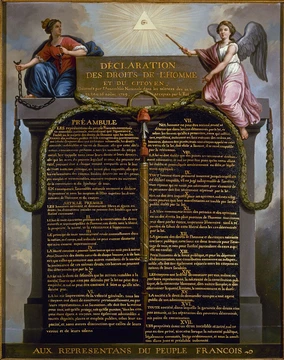
Natural rights and legal rights
Natural rights are universal; legal rights depend on human laws.

Natural rights and legal rights are two categories of rights distinguished by some philosophers. Natural rights are universal, fundamental, and inalienable, not dependent on any particular culture or government, while legal rights are bestowed by a given legal system and can be modified or repealed by human laws. The distinction has shaped debates about justice, government legitimacy, and human rights.
- field
- Philosophy of law, political philosophy
- known_for
- Distinction between natural rights (universal, inalienable) and legal rights (granted by legal systems)
- related_concepts
- Natural law, positive law, human rights, iusnaturalism
Lore & Background
The concept of natural law first appeared in ancient Greek philosophy and was referred to by Roman philosopher Cicero. Conversely, the concept of natural rights is used by others to challenge the legitimacy of all such establishments.
Reader's Guide
The distinction between natural and legal rights is significant because it underpins debates about the foundation of human rights and the legitimacy of laws. Iusnaturalism holds that legal norms follow a human universal knowledge, viewing enacted laws that contradict such knowledge as unjust. However, the concept of natural rights is not universally accepted, partly due to its religious associations and perceived incoherence; some philosophers, like Jeremy Bentham, called natural rights 'simple nonsense.' The idea that certain rights are natural or inalienable has a history dating back to the Stoics of late Antiquity, through Catholic law of the early Middle Ages, the Protestant Reformation, and the Age of Enlightenment. Different philosophers have designed different lists of natural rights; almost all include the right to life and liberty. John Locke emphasized 'life, liberty and property,' while Thomas Jefferson substituted 'pursuit of happiness' in the United States Declaration of Independence.
Did You Know?
- Natural rights are considered inalienable, but one can forfeit their enjoyment through actions such as violating someone else's rights.
- Jeremy Bentham called natural rights 'simple nonsense.'
- John Locke emphasized 'life, liberty and property' as primary natural rights, while Thomas Jefferson substituted 'pursuit of happiness' in the U.S. Declaration of Independence.
Frequently Asked Questions
What is the core distinction between natural rights and legal rights?
Natural rights are treated as universal, inalienable, and independent of any particular government, while legal rights are created by a specific legal system and can be altered or revoked by legislation. The two-part framework helps clarify whether a claim to a right rests on human nature itself or on a statutory grant.
Which philosophical traditions are most associated with the natural-rights versus legal-rights distinction?
The idea sits at the crossroads of natural law theory, political philosophy, and iusnaturalism, and it draws heavily on the broader natural-law-versus-positive-law debate. Thinkers in these traditions have used the split to argue about where legitimate authority to grant or limit rights actually resides.
Why does this distinction matter in constitutional law?
It frames the central question of whether a constitution protects rights that pre-exist the state or merely codifies privileges the state chooses to bestow. That framing directly shapes debates over judicial review, the enforcement of human rights, and the limits of legislative power.
Are natural rights truly inalienable, or is that just a philosophical claim?
Within the tradition, natural rights are described as inalienable and universal, meaning no culture or government can legitimately strip them away. In practice, whether a right is treated as inalienable depends on which philosophical framework and legal system a given jurisdiction adopts.
How do human rights and positive law relate to the natural-rights/legal-rights split?
Human-rights discourse often borrows the universalist language of natural rights while being implemented through positive (enacted) legal systems, blending both categories. Positive law, by contrast, refers to the rules a particular state has passed and corresponds more closely to the legal-rights side of the distinction.
More in Constitutional Law 1-24
Elsewhere in the Constitutional Law universe
Spotted an error? Know more?
This is a living reference — every entry is fact-audited, and reader corrections feed straight into our audit queue. Suggest an edit · See this site's audit record